




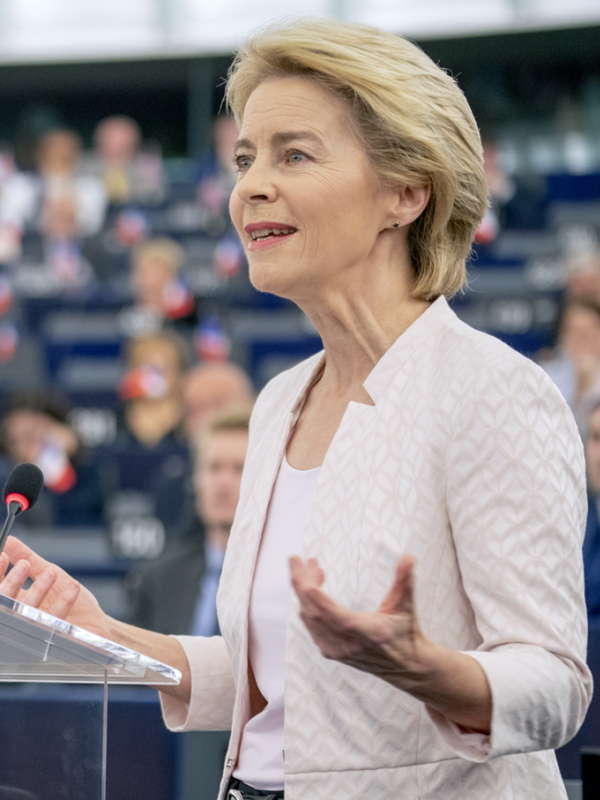
Foto: „Ursula von der Leyen presents her vision to MEPs“ (cropped) by European Parliament; CC-BY-4.0
| Seat | Brussels |
| President | Ursula von der Leyen (EPP) |
| Number of members | 27 |
Composition and Election
The European Commission consists of a President and 26 Commissioners. Each of the 27 EU Member States appoints one Commissioner. However, Members of the Commission may not accept or seek instructions from a national government. Unlike in the Council (Council of Ministers), Commissioners and Commission staff therefore carry out their duties in complete independence from their home countries. The Commission does not represent the interests of a particular Member State, but those of the EU as a whole. Like the ministers in a government, the Commissioners are each responsible for specific policy areas. For example, there is currently (2022) a Commissioner for Trade, a Commissioner for the Environment and a Commissioner for Energy.
The President of the European Commission is elected by the European Parliament on the recommendation of the European Council (i.e. the Heads of State or Government). Once the Commission President has been elected, the Council of Ministers draws up a list of candidates it proposes to the European Parliament as members of the Commission. The Parliament conducts detailed hearings with all the proposed Commissioners and then votes on the Commission as a whole. The term of office of the European Commission is five years. As the European Commission is only confirmed by the European Parliament and not elected, it cannot rely on a fixed majority in Parliament. This also means that, unlike in the parliaments of nation states, there is no clear distinction in the European Parliament between government and opposition groups.
Responsibilities
The Commission essentially has five responsibilities:
Monopoly on legislative initiative
The Commission is often described as the driving force behind European integration, because it is the only institution that can propose new EU legislation. The Commission is (with a few exceptions) the only institution that possesses this so-called right of initiative. It thus holds the ‘key’ to starting the ‘engine’ for any new EU initiative. The reason for this monopoly on the right of initiative is that, as a supranational body, the Commission is best placed to ensure that it puts forward balanced proposals in the common interest of the EU as a whole, free from national or regional interests. However, it may be called upon by the European Parliament (EP) or the Council to submit a suitable proposal on a specific issue (indirect right of initiative).
Executive powers
In day-to-day terms, the Commission is primarily the EU’s administrative centre. In accordance with the principle of subsidiarity, the Commission implements EU policies insofar as this cannot be done by the authorities of the Member States. The principle of subsidiarity ensures that the EU only takes action when the Member States cannot satisfactorily achieve an objective and that this objective can be better achieved at Union level. The Commission is authorised by the Council and, where applicable, the European Parliament to adopt implementing regulations necessary for the practical implementation of legislative acts. It implements EU programmes, for example in the fields of education, research and culture (e.g. the Erasmus+ programme).
Budgetary powers
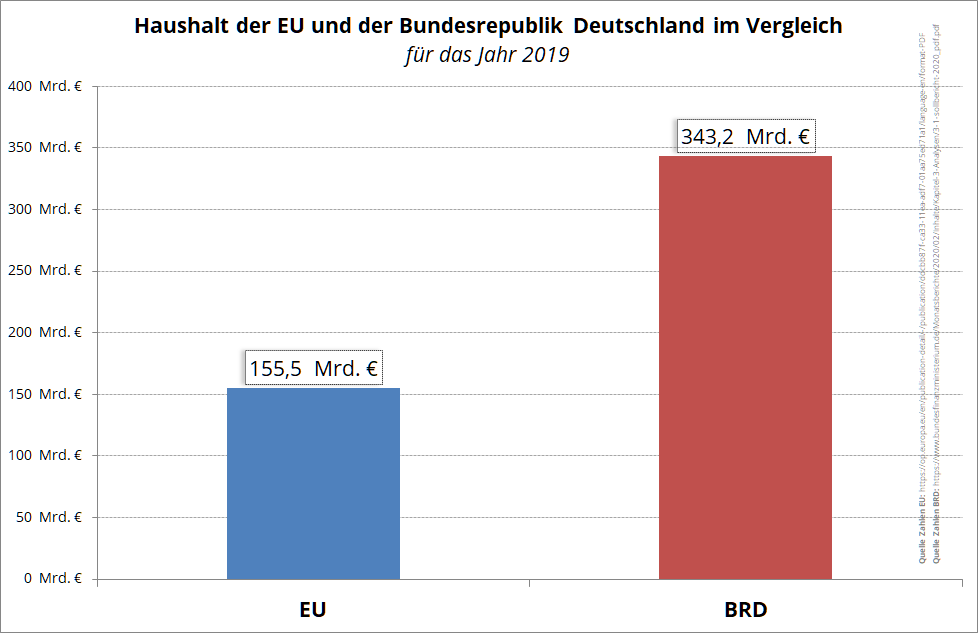
Haushalt der EU und der Bundesrepublik Deutschland im Vergleich für das Jahr 2019
(Quelle Zahlen EU: https://op.europa.eu/en/publication-detail/-/publication/ddcbb87f-ca33-11ea-adf7-01aa75ed71a1/language-en/format-PDF; Quelle Zahlen BRD: https://www.bundesfinanzministerium.de/Monatsberichte/2020/02/Inhalte/Kapitel-3-Analysen/3-1-sollbericht-2020_pdf)
The Commission also acts as the EU’s treasurer. It collects information from all EU institutions and bodies regarding their financial requirements for the coming year and then draws up the draft EU annual budget. In doing so, it must take into account the annual expenditure ceiling set out in the multiannual financial framework. Once the budget has been adopted by the European Parliament and the Council, the Commission is responsible for the management and implementation of the EU budget and determines the precise allocation of budgetary resources. All EU revenue and expenditure is managed by the Commission. Around 80 per cent of the budgetary resources are channelled back by the Commission to the Member States, whose authorities are responsible for the use of the funds or their disbursement to beneficiaries.
Powers of supervision
The Commission is also known as the ‘Guardian of the Treaties’, as it monitors the proper implementation and application of EU law. If a Member State infringes EU law, the Commission must intervene and, if necessary, bring proceedings before the Court of Justice of the European Union. The Commission is also the EU’s supreme competition authority. It can prohibit mergers between companies if they would hinder competition.
Conducting negotiations
The Commission is Europe’s voice in the world, with the exception of the area of the Common Foreign and Security Policy. Since the Treaty of Lisbon came into force, the latter has been the prerogative of the High Representative of the Union. The High Representative, however, is also Vice-President of the Commission and thus part of the College of Commissioners. The Commission receives a mandate from the Council to negotiate treaties such as association or trade agreements between the EU and other states, groups of states or international organisations. It is also responsible for negotiations on accession treaties with candidate countries.