





Photo: “Roberta Metsola elected new President of the European Parliament“ (cropped) by European Parliament; CC BY 2.0
| Seat | Strasbourg/Brussels |
| President | Roberta Metsola (EPP) |
| Number of members | 720 |
Composition
The European Parliament (EP) consists of representatives from the 27 EU Member States. They are directly elected by EU citizens every five years and represent their interests. Each country sends a specific number of members, which is determined by the country’s population (see table below). The Members of the European Parliament (MEPs) almost always belong to a national political party. Within the European Parliament, the national parties have formed EU-wide political groups, and most MEPs belong to one of these (see figure).
 Photo: “The Political groups of the European Parliament” by European Parliament; CC BY 2.0
Powers
The EP has four key powers:
Legislative powers
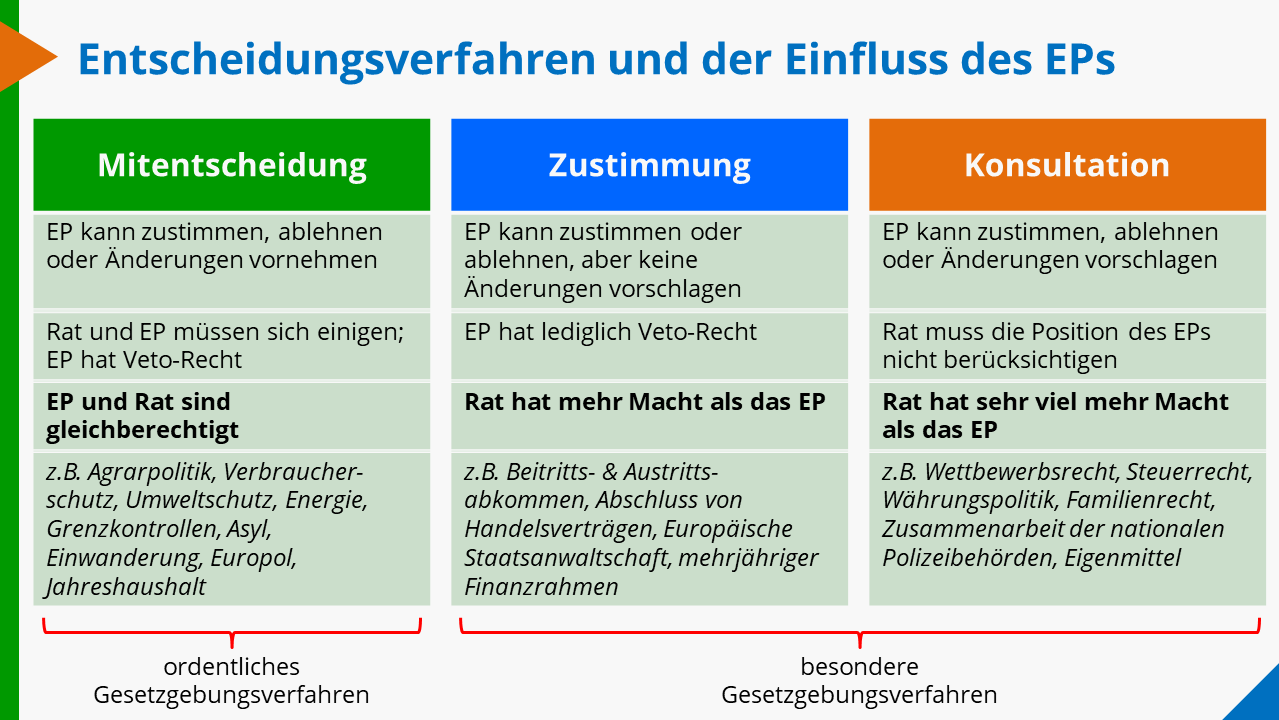
Ordentliches und besondere Gesetzgebungsverfahren – Einfluss des Europäischen Parlaments
(zum Vergrößern klicken)
The European Parliament (EP) is one of the EU’s two co-legislators, alongside the Council (Council of Ministers). However, only the European Commission can propose new laws; with a few exceptions, it has the sole right of initiative. Whilst the EP cannot propose legislation itself, it has the right to call on the Commission to submit a proposal.
In most policy areas (e.g. agricultural policy, environmental protection and consumer protection), the so-called ‘ordinary legislative procedure’ applies, in which the Council and the European Parliament are co-legislators on an equal footing. This means that both the Council and the European Parliament can propose amendments to a legislative proposal by the European Commission, and that a law is only passed if both institutions reach agreement.
However, there are some policy areas in which so-called ‘special legislative procedures’ apply. In these cases, the Council has more power than the European Parliament. In some cases (e.g. trade policy, accession treaties), the Council must seek the European Parliament’s consent, but the Parliament cannot put forward its own amendments. In other cases (e.g. monetary policy, tax law), the Council is only required to consult the European Parliament; that is to say, the Council must give the EP the opportunity to give its position, but may disregard it.
| Member State | MEP |
| Belgium | 22 |
| Bulgaria | 17 |
| Denmark | 15 |
| Germany | 96 |
| Estonia | 7 |
| Finland | 15 |
| France | 81 |
| Greece | 21 |
| Ireland | 14 |
| Italy | 76 |
| Croatia | 12 |
| Latvia | 9 |
| Lithuania | 11 |
| Luxembourg | 6 |
| Malta | 6 |
| Netherlands | 31 |
| Austria | 20 |
| Poland | 53 |
| Portugal | 21 |
| Romania | 33 |
| Sweden | 21 |
| Slovakia | 15 |
| Slovenia | 9 |
| Spain | 61 |
| Czech Republic |
21 |
| Hungary | 21 |
| Cyprus | 6 |
| TOTAL | 720 |
Budgetary powers
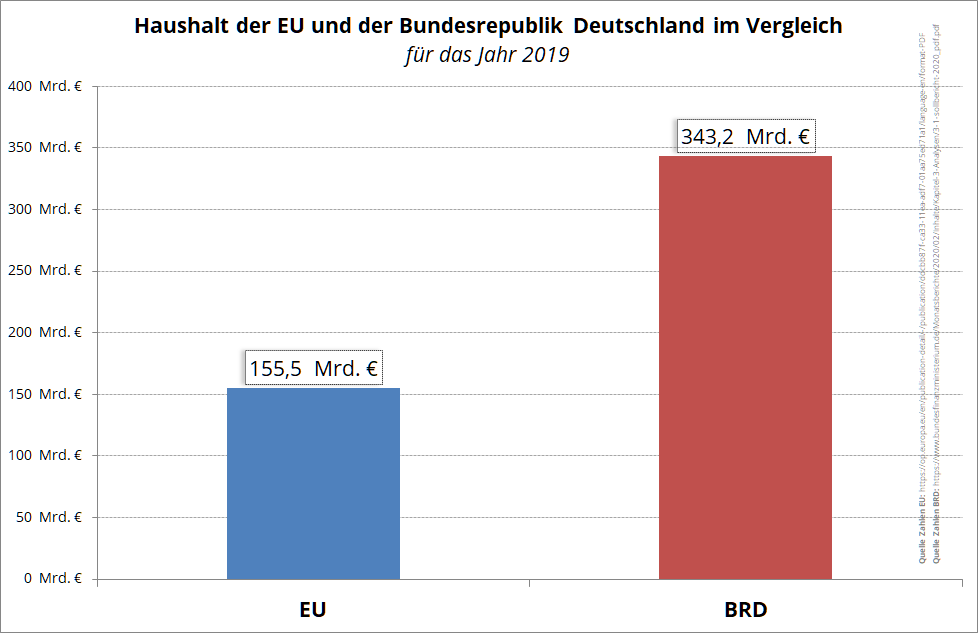
Comparison of the budgets of the EU and the Federal Republic of Germany for 2019
(Source numbers EU: https://op.europa.eu/en/publication-detail/-/publication/ddcbb87f-ca33-11ea-adf7-01aa75ed71a1/language-en/format-PDF; Source numbers Germany: https://www.bundesfinanzministerium.de/Monatsberichte/2020/02/Inhalte/Kapitel-3-Analysen/3-1-sollbericht-2020_pdf)
Since the Treaty of Lisbon came into force, the European Parliament and the Council have jointly decided on the EU’s draft annual budget proposed by the Commission. However, they must adhere to the annual expenditure ceilings set out in the multi-annual financial framework, which is adopted every seven years by the Council with the consent of the European Parliament. Finally, on the Council’s recommendation, the EP decides each year whether to grant the Commission a discharge, that is to say, the final approval of all expenditure for a financial year.
Powers of scrutiny
The EP exercises democratic scrutiny over the other institutions. It elects the President of the Commission, proposed by the European Council, as well as the College of Commissioners, proposed by the European Council in conjunction with the Council. Since 1994, Commissioners-designate have also been required to appear before the EP for a hearing. The EP may also force the entire Commission to resign by passing a motion of no confidence. The Commission reports regularly to the EP, including in the form of an annual report on the EU’s activities and on the implementation of the budget.
In addition, MEPs regularly submit written or oral questions to the Commission or the Council, which are obliged to respond. The establishment of committees of inquiry and the processing of petitions from EU citizens provide further means of parliamentary scrutiny.
Powers in external relations
The European Union may conclude agreements with other countries or international organisations. These generally require the consent of the European Parliament. This applies, amongst other things, to the following cases:
- Trade agreements
- Accession and association agreements
- Treaties entailing significant financial implications for the EU
Expenditure on foreign and security policy actions financed from the EU budget may be scrutinised by the EP.
However, in matters relating to the Common Foreign and Security Policy, the European Parliament is excluded from the decision-making process. This applies, amongst other things, to the adoption of sanctions (e.g. against third countries like Russia, organisations or individuals) and the conduct of missions under the Common Security and Defence Policy.