




| Seat | Brussels |
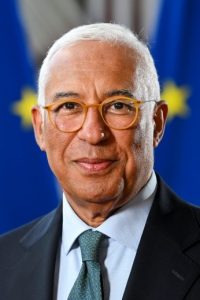
| President | António Costa (SPE) |
| Number of members | 27 voting und 3 non-voting members (President of the European Council, President of the European Commission, High Representative for Foreign Affairs and Security Policy) |
Composition
The European Council comprises the Heads of State or Government of the 27 EU Member States, the President of the European Council, the President of the European Commission and the High Representative of the Union for Foreign Affairs and Security Policy. They meet regularly at so-called summits. However, only the Heads of State or Government have the right to vote. The European Council takes decisions by consensus, i.e. unanimously.
President of the European Council
Since the end of 2009, the European Council has had a full-time President. The President is elected by the Heads of State or Government by a qualified majority for a term of two and a half years and may be re-elected once. However, as the President of the European Council does not have the right to vote, they act more as a coordinator and facilitator. They convene the European Council, draw up the agenda and the conclusions, prepare the meetings and chair the discussions. In this way, they can – as provided for in the Treaty – provide impetus for the work of the European Council. Furthermore, they represent the EU ‘at their level’, that is, in dealings with Heads of State or Government on the international stage. Since 1 December 2024, the former Portuguese Prime Minister António Costa has held the office of President of the European Council.
Responsibilities
The European Council plays a prominent political role within the institutional framework. It provides the EU with the impetus necessary for its development. To do so, it sets out the general political objectives and priorities in the form of so-called conclusions. The European Council also determines the principles and general guidelines of the Common Foreign and Security Policy (CFSP) and of economic and monetary policy. The Treaty of Lisbon further enhanced the European Council’s standing by granting it the status of an institution. In the wake of the euro crisis, the European Council has gained further significance as a governing body. Unlike the Council and the European Parliament, the European Council does on paper not possess any legislative powers; this is expressly stated in the Treaty on the Functioning of the European Union. In practice, however, the European Council intervenes significantly in the legislative process through detailed conclusions.
On power structures: The difference between the European Council and the Council of Ministers
Thomas Mayer | 5 January 2014, 12:00
[…]The European Council as the EU’s most powerful decision-making body
[…] The [European Council], often colloquially referred to as the ‘EU summit’, is the body comprising the 28 [now 27] Heads of State or Government of the Union. As such, in its current form, it is politically the most powerful decision-making body in the EU. This is because it is the European Council that sets the broad political direction, adopts binding decisions itself, and issues mandates to the European Commission or the Council of the European Union. This was not the case until December 2009, when the Treaty of Lisbon came into force. Until then, the Heads of State or Government were limited to setting only the broad political and economic direction. Binding decisions, on the other hand, were taken in the specialist Councils of Ministers or the General Affairs Council of the EU (de facto by the foreign ministers), and had to be painstakingly negotiated by the ministers first.Shift in the balance of power
Some experts therefore regard the redefinition of the European Council as the most significant change in the Treaty of Lisbon, because in practice this has resulted in a decisive shift in the balance of power. The European Commission, as a Community institution, has been weakened, as have the EU Councils of Ministers, which, in cases of doubt, now serve merely as ‘messengers’ for the heads of government. This is already evident on the surface. Until 2009, EU summits took place four times a year, with occasional special summits. And the foreign ministers were present at the summits alongside their heads of government. Today, apart from the Secretary-General of the Council, very few people are allowed in the chamber when ‘the leaders’ meet. The foreign ministers have been stripped of their power and are not directly privy to how decisions are made at the summit. Since 2009, there has also been a Permanent President of the European Council, […], who, in terms of protocol, represents the Union externally, on an equal footing with, for example, the US President. Together with the President of the European Commission, […], he forms a sort of dual leadership of the Union. EU summits now take place almost exclusively in Brussels, averaging six to eight per year. During the crisis years of 2010 and 2011, the heads of government met almost every month.
EU Council Presidency
As a result of all this, the role of the Council Presidency ([…]), which rotates among Member States every six months, has been scaled back. Together with the Commission and the Council Secretariat in Brussels, it organises the day-to-day running of the EU, in particular the proceedings of the specialist ministerial councils, where most formal decisions on EU legislation are taken in conjunction with the European Parliament. The European Council, which has restored greater power to the nation states, also makes the most important appointments. For example, it nominates the President of the Commission (although the European Parliament has had a guaranteed right of codecision in this regard since 2009) or the High Representative for Foreign Affairs. Furthermore, the EU heads of state and government in the [European Council] are responsible for amending the EU Treaties, whether through a fast-track procedure carried out by themselves or by convening a Convention in which the national parliaments and the European Parliament also participate in a binding capacity.