




| Seat | Brussels |
| Chair | Council formation „Foreign Affairs“: High Representative for Foreign Affairs and Security Policy All other Council formations: Representative of the member state that holds the Council presidency (1st half of 2026: Cyprus / 2nd half of 2026: Ireland) |
| Number of members | 27 |
Composition
The Council of the EU (also known as the Council of Ministers or simply the Council) represents the interests of the Member States. To this end, the relevant ministers from each Member State are represented in the Council. The composition varies according to the policy area. Depending on the issue at hand, for example, all environment ministers, all finance ministers, all justice ministers and so on meet. In total, there are 10 different configurations of the Council. Despite this diversity, the Council is a single body.
All ministerial meetings (known as ‘Councils’) are prepared by the ‘Committee of Permanent Representatives’ (Coreper), which meets weekly. It comprises the Permanent Representatives of the Member States – that is, the ambassadors to the EU – and their deputies. They examine draft decisions and legislative proposals, put forward amendments and work out compromises that enable agreement to be reached within the Council.
Council Presidency
The presidency of the Council of the EU rotates every six months amongst the Member States. Germany most recently held the presidency in the second half of 2020. One of the presidency’s tasks is to devise proposed solutions when negotiations reach an impasse.
Responsibilities
Legislative powers
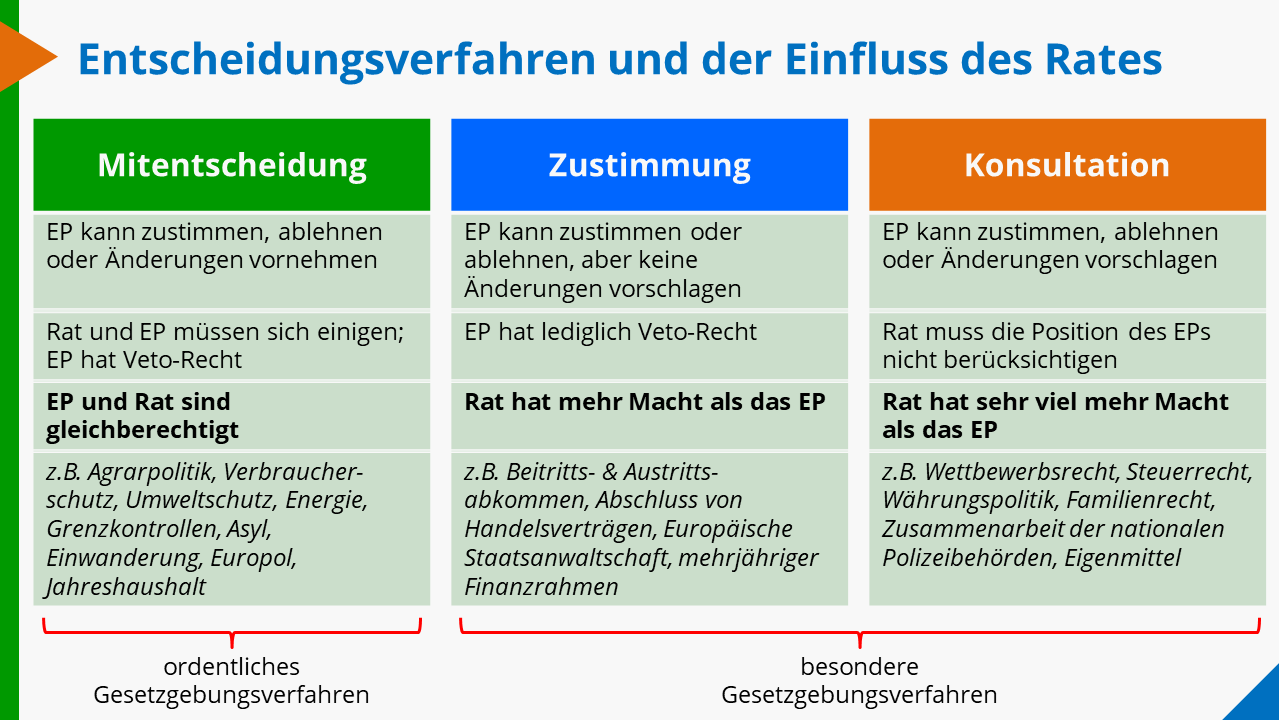
Ordentliches und besondere Gesetzgebungsverfahren – Einfluss des Rates
(zum Vergrößern klicken)
The Council is one of the EU’s two co-legislators, alongside the European Parliament (EP). However, only the European Commission can propose new laws; with a few exceptions, it has the sole right of initiative.
In most policy areas (e.g. agricultural policy, environmental protection and consumer protection), the so-called ‘ordinary legislative procedure’ applies, in which the Council and the European Parliament are co-legislators on an equal footing. This means that both the Council and the European Parliament can propose amendments to a legislative proposal by the European Commission, and that a law is only passed if both institutions reach agreement.
However, there are some policy areas in which so-called ‘special legislative procedures’ apply. In these cases, the Council has more power than the European Parliament. In some cases (e.g. trade policy, accession treaties), the Council must seek the European Parliament’s consent, but the Parliament cannot put forward its own amendments. In other cases (e.g. monetary policy, tax law), the Council is only required to consult the European Parliament and may disregard its position.
Budgetary powers
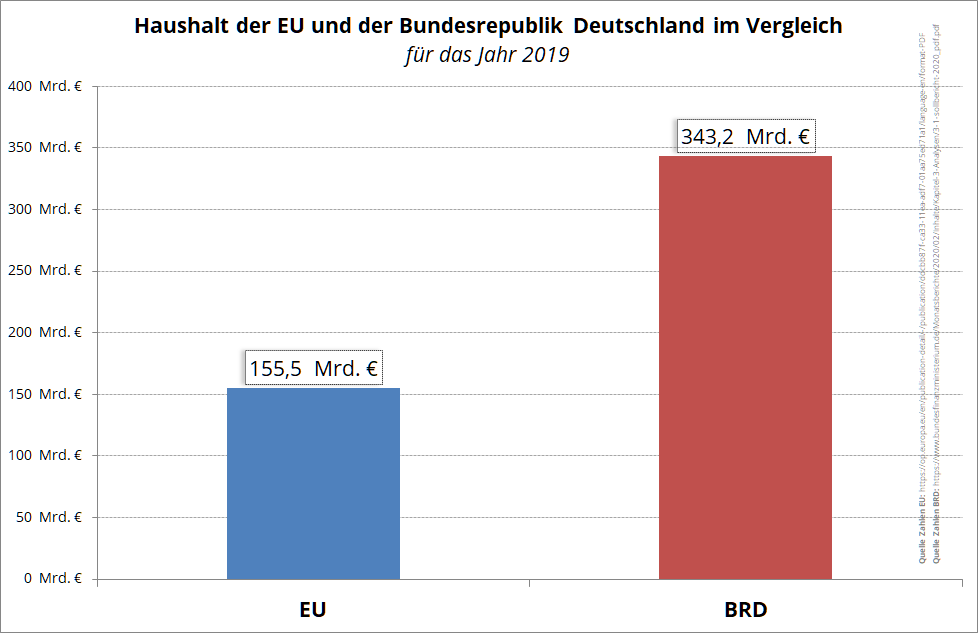
Haushalt der EU und der Bundesrepublik Deutschland im Vergleich für das Jahr 2019
(Quelle Zahlen EU: https://op.europa.eu/en/publication-detail/-/publication/ddcbb87f-ca33-11ea-adf7-01aa75ed71a1/language-en/format-PDF; Quelle Zahlen BRD: https://www.bundesfinanzministerium.de/Monatsberichte/2020/02/Inhalte/Kapitel-3-Analysen/3-1-sollbericht-2020_pdf)
Together with the European Parliament, the Council forms the EU’s budgetary authority, which adopts the EU’s annual budget. Every seven years, it also adopts the multiannual financial framework, subject to the European Parliament’s approval.
Other powers
Furthermore, the Council develops the EU’s Common Foreign and Security Policy on the basis of the general guidelines laid down by the European Council. It ensures the coordination of Member States’ economic policies and, subject to the competences of the European Central Bank (ECB), takes policy decisions in the monetary field. Finally, it also concludes the EU’s international treaties negotiated by the Commission.